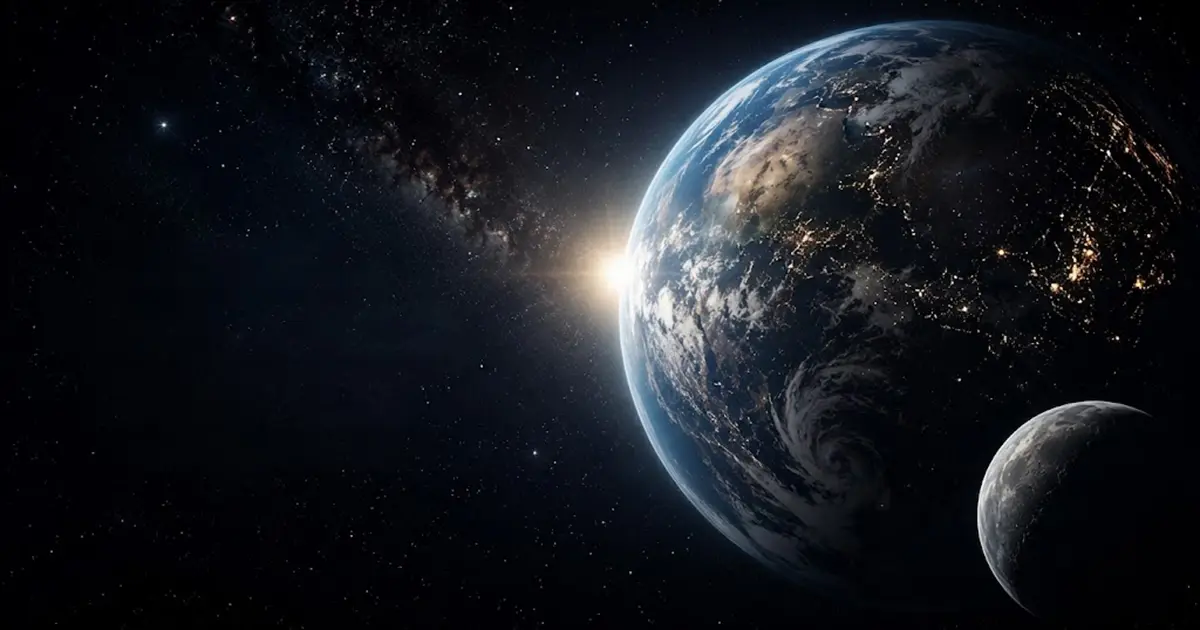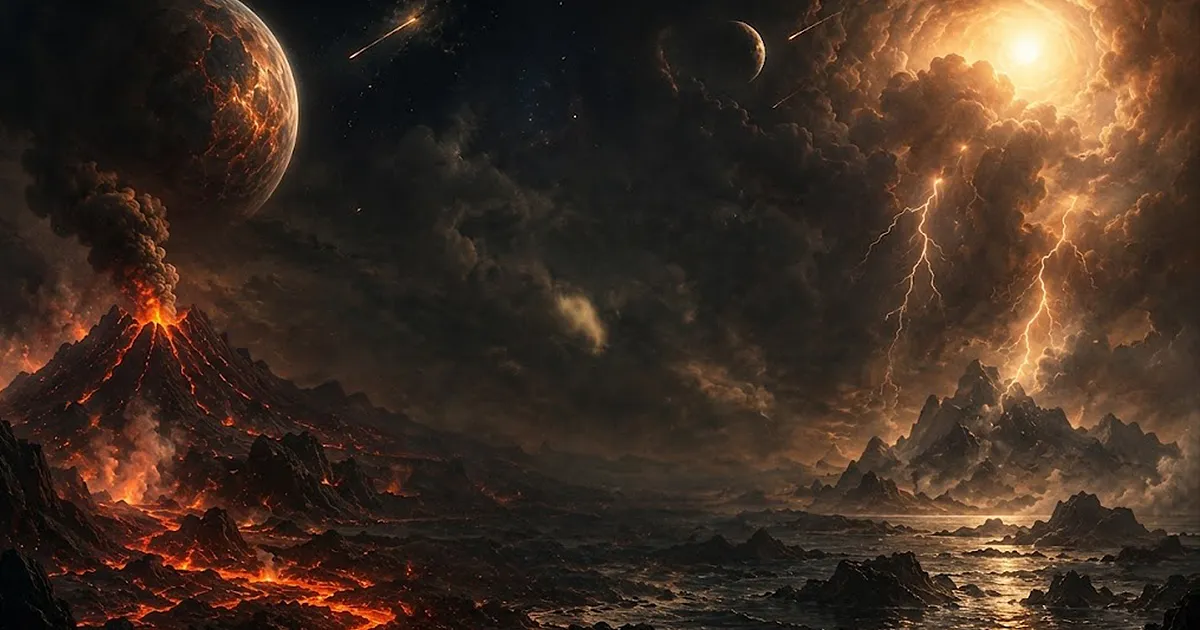
Before Humanity Remembered, There are moments in human history that feel ancient. The rise of forgotten kingdoms. The fall of empires. The first fire burning beneath a dark sky. Yet against the age of the universe, even the oldest human memory disappears almost instantly. Humanity measures history in centuries.
The cosmos measures it in eternities.
Long before oceans touched the shores of continents… before mountains rose from the Earth… before the first living organism drifted silently through primordial seas… our planet existed as something violent, molten, and almost unrecognizable.
A world of fire.
A world without life.
A world still being born.
Modern science tells us that Earth formed approximately 4.5 billion years ago — a number so immense that the human mind struggles to truly understand it.
Four and a half billion years.
Not merely thousands of generations.
Not the rise and fall of civilizations.
But ages so vast that entire oceans could appear and disappear before humanity ever arrived.
Even now, astronomers continue searching the heavens for clues about those forgotten beginnings.
Across the universe, enormous spirals of gas and dust drift silently through space — colossal nebulae illuminated by distant stars.
The universe still remembers its beginnings.
And sometimes… through telescopes pointed into the darkness… humanity catches brief glimpses of that memory.
The Birth of a World
The early twentieth century produced some of the first extraordinary photographs of spiral nebulae — mysterious celestial structures that transformed humanity’s understanding of the cosmos.
At the time, these strange spirals appeared almost ghostly. Vast rotating islands of light suspended in endless darkness.
Some scientists believed our own Sun and planets were once born from such a cosmic whirlpool — a rotating cloud of gas, dust, and incandescent matter slowly collapsing under gravity across unimaginable ages.
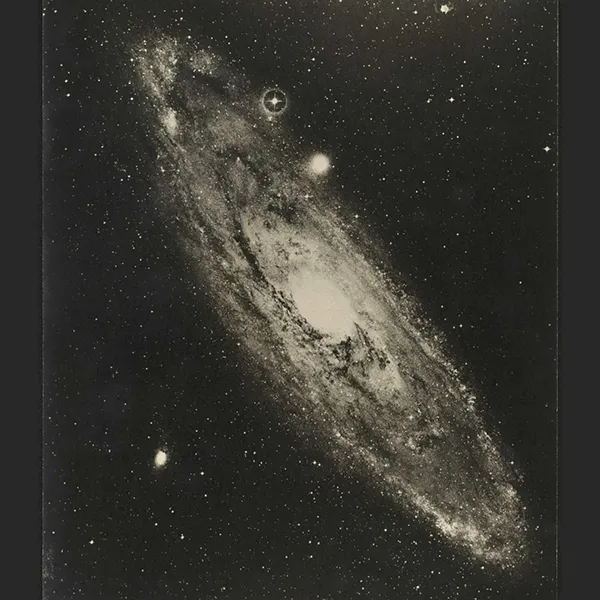
And somewhere within that silent rotation… the Earth began.
Not as forests.
Not as oceans.
But as fire.
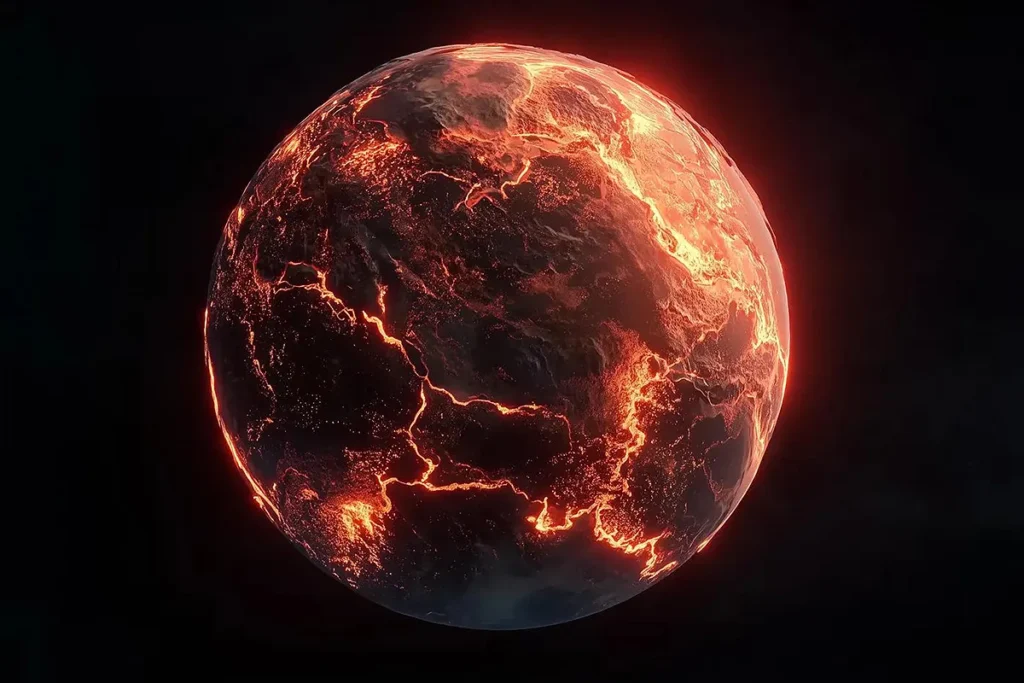
he young solar system was chaotic beyond imagination.
Worlds collided.
Fragments of rock and metal spiraled endlessly around the newborn Sun. Temperatures rose to catastrophic extremes as gravity slowly forged planets from cosmic debris.
The Earth itself was once little more than a molten sphere drifting through darkness.
The Moon hung far closer to our planet than it does today.
Enormous tides tore across the unstable surface while meteors rained endlessly from the heavens.
The universe was still unfinished.
When Earth Was Fire
If we could travel backward across billions of years, the Earth would not resemble the blue world we know today.
There would be no rivers.
No forests.
No clouds drifting peacefully above continents.
The planet itself would glow.
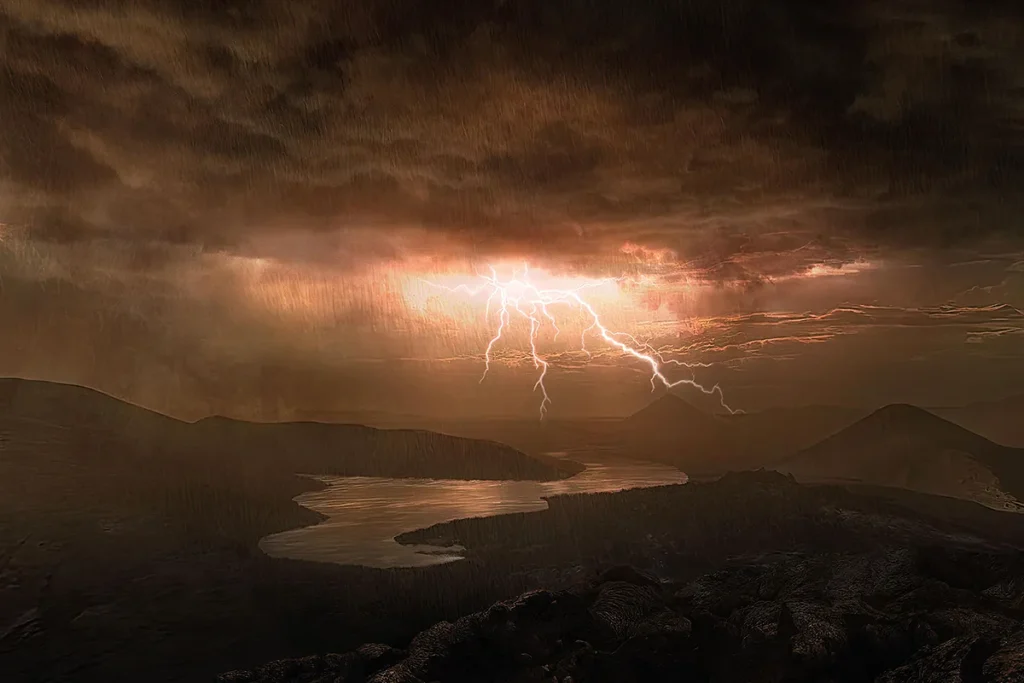
Molten oceans of rock churned beneath a suffocating atmosphere thick with steam, ash, and toxic gases. Volcanoes erupted endlessly across the surface while lightning storms illuminated a sky blackened by smoke and fire.
The young Sun burned brighter overhead, casting its light upon a world trapped between creation and catastrophe.
Earth was not born peacefully.
“The nitrogen in our DNA, the calcium in our teeth, the iron in our blood… were made in the interiors of collapsing stars.”
— Carl Sagan
That may be one of the most extraordinary truths humanity has ever discovered.
Everything around us — every mountain, every ocean, every living creature — emerged from ancient cosmic processes older than civilization itself.
The Earth is not separate from the universe.
It is one of its memories.
The First Rain
Slowly, across millions upon millions of years, the violence began to fade.
The surface cooled.
Steam condensed into clouds.
And for the first time in Earth’s history… rain fell.
Not gentle rain like today.
But endless planetary storms.
Water hissed against burning rock. Torrents carved the first wounds into the planet’s surface. Primitive oceans began gathering beneath skies filled with volcanic ash and constant lightning.
The world was changing.
Very slowly.
Almost invisibly.
But deep time does not hurry.
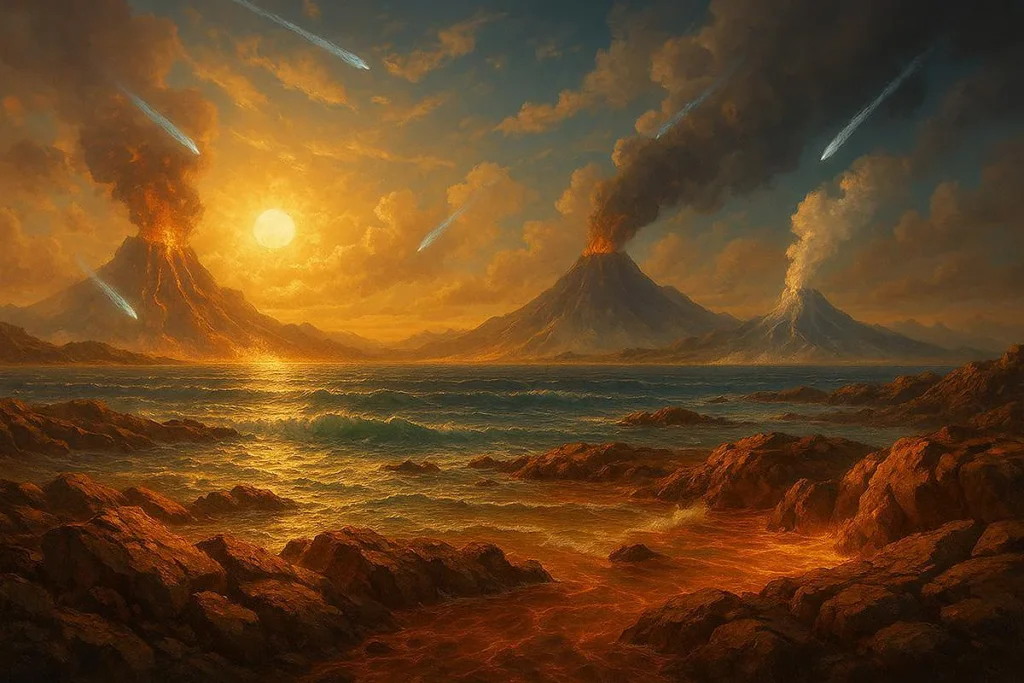
Scientists now believe these early oceans may have become the cradle of life itself.
Somewhere within those dark waters, chemistry slowly transformed into biology.
Atoms formed molecules.
Molecules formed structures.
And eventually… something began to live.
No witnesses saw it happen.
No civilization recorded it.
Yet every living thing on Earth may trace its existence back to that silent moment hidden within ancient seas billions of years ago.
The Silence Before Life
What makes deep time so difficult to comprehend is not simply its scale.
It is the realization that humanity exists only at the very edge of Earth’s story.
If the history of our planet were compressed into a single day, human civilization would appear only in the final seconds before midnight.
Everything we have ever built…
every empire…
every religion…
every war…
every love story…
would occupy less than a breath.
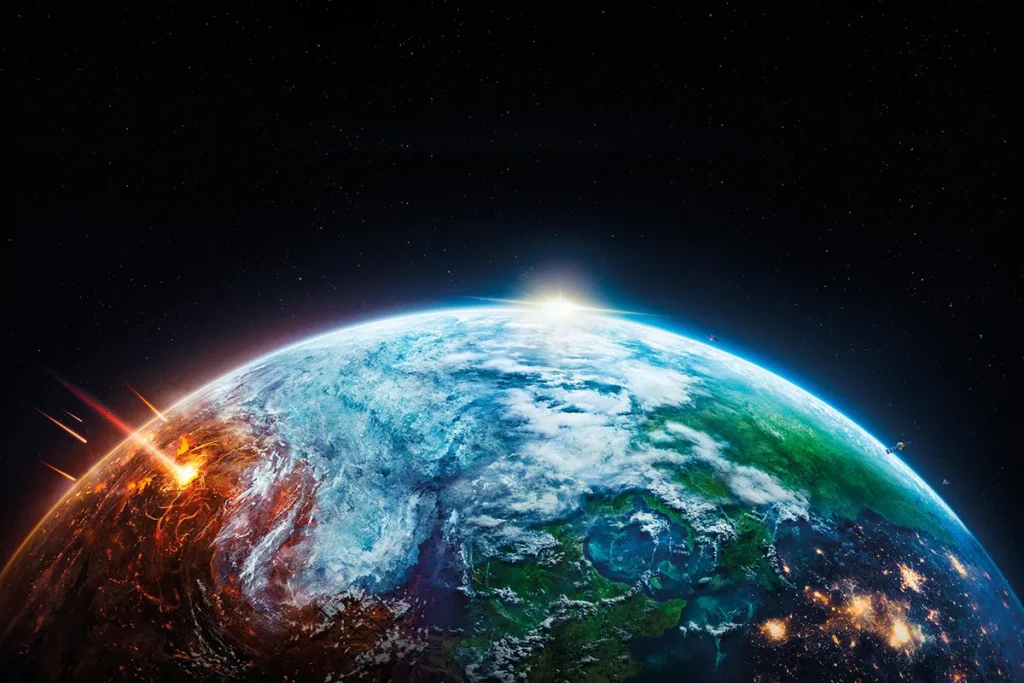
“Time is a sort of river of passing events, and strong is its current.”
— Marcus Aurelius
Ancient philosophers sensed humanity’s smallness long before telescopes revealed the true scale of the cosmos.
Today, modern astronomy has only deepened that realization.
The universe is older, larger, and stranger than our ancestors could ever imagine.
And still… humanity continues searching.
The Age Beyond Memory
The rocks beneath our feet are archives of forgotten worlds.
Inside them lie the scars of vanished oceans, extinct species, catastrophic extinctions, and ancient climates that existed long before humans walked the Earth.
Entire worlds have come and gone here.
The Earth we know today is only the latest version of something constantly changing.
Even continents themselves drift slowly across the planet over immense periods of time. Mountains rise and collapse. Oceans open and disappear. Ice ages advance and retreat.
Nothing remains forever.
Not even worlds.
And perhaps that is what makes Earth so extraordinary.
It is not static.
It is alive with time.
A planet shaped continuously by destruction, transformation, and renewal.
The atoms that form our bodies once drifted through ancient stars. The ground beneath our cities was forged through catastrophic geological violence billions of years ago.
Humanity stands upon the ruins of unimaginable ages.
Yet most of those ages are gone forever.
Lost beneath oceans.
Buried beneath stone.
Erased by time itself.
The Universe Remembers
Still, traces remain.
In distant galaxies rotating silently across the universe.
In volcanic rocks older than civilization.
In the fossils of creatures that vanished long before humans existed.
And in the night sky itself.
Every star above us is a reminder that creation never truly ended.
The universe is still unfolding.
Still evolving.
Still becoming.
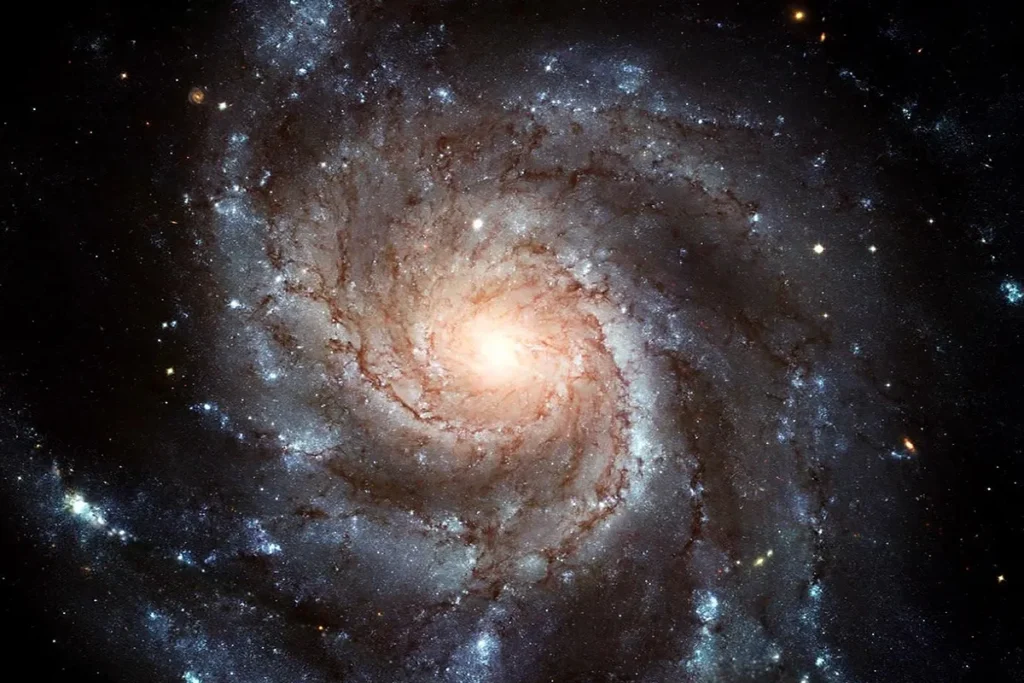
There is something deeply humbling about deep time.
Human beings often imagine themselves at the center of existence.
But the history of Earth tells another story.
For billions of years, the universe continued perfectly well without us.
Mountains rose without witnesses. Oceans formed in silence. Storms crossed empty continents where no living eyes existed to see them.
And yet somehow… from all that chaos… consciousness emerged.
Humanity arrived late in the story.
But perhaps our role was never to conquer the universe.
Perhaps it was simply to observe it.
To remember it.
To ask questions beneath the stars.
“We are a way for the cosmos to know itself.”
— Carl Sagan
Maybe that is why humanity has always looked upward.
Because somewhere deep within us… we remember.
The fire of ancient stars.
The violence of creation.
The endless passage of time.
The universe lives within us because we were born from it.
And one day, long after humanity disappears, time will continue its silent journey across the stars.
Galaxies will still turn slowly in the darkness.
New worlds will still rise from cosmic dust.
And somewhere in the endless future of the cosmos… another civilization may stand beneath another sky and wonder how everything began.